Fresh facts have emerged on why the Senate President, Godswill Akpabio and the Senator representing Edo North Senatorial District, Adams Oshiomhole, clashed over the amended Senate standing rules yesterday.
The rules have been interpreted to imply added restrictions to the eligibility for principal and presiding officers in the 11th Senate, which barring hitches, is expected to be inaugurated in June, 2027.
It also shuts the door of eligibility against both would-be senators and those not privileged to have have served back-to-back in the 9th and 10th Senate.
Those expected to be in the 11th Senate include governors currently serving their second terms who are gunning for the Senate and those serving or who served only a term in the National Assembly and are planning to come back.
Governors serving their second terms who are vying for the Senate in 2027 include: Inuwa Yahaya of Gombe; Mai Mala Buni of Yobe, Abdullahi Sule of Nasarawa, Bala Mohammed of Bauchi; Dapo Abiodun of Ogun and Abdulrahman Abdulrazaq of Kwara.
In the category of those who were previously in the Senate are Senators Hope Uzodimma, Imo; Kabiru Marafa, Zamfara Central while Adams Oshiomhole, Edo North is currently serving his first term.
Our correspondent reports that the Senate, after a closed door session on Tuesday, amended its standing rules to introduce measures that screen out many that would have aspired for principal and presiding officers positions.
The amended order 4 states that: “Nomination of Senators to serve as Presiding Officers shall be in accordance with the ranking of Senators and shall be strictly adhered to.
“The order of ranking are (i) Former President of the Senate, (ii) Former Deputy President of the Senate, (iii) Former Principal Officers of the Senate, (iv) Senators who had served at least one term of four years, (v) Senators who had been members of the House of Representatives, (vi) In the absence of i to v, Senators elected into the Senate for the first time.”
Aside the order of ranking used to narrow the window of eligibility among senators – elect for the presiding positions, the 10th Senate went further with additional provision in Order 5 to knock off freshers in the contest.
The order states: “ Any Senator shall not be eligible to contest for any Principal Office of the Senate unless he has served as a Senator for at least two consecutive terms immediately proceeding nomination,’’ which means that Senators who were not in the 9th and current 10th Senate, are not eligible to vie for presiding officers’s positions in the 11th Senate.
Why many seek presiding officers positions
Our correspondent further reports presiding officers positions in the Senate are President of the Senate and Deputy President of the Senate while Principal officers positions are Senate Leader, Deputy Senate Leader, Chief Whip and Deputy Whip of the Senate.
Others are Minority Leader, Deputy Minority Leader, Minority Whip and Deputy Minority Whip.
The president of the Senate is a very powerful position. He is the number three in the pecking order of political office holders in the country after the President and Vice President.
He is the head of the legislative arm of government and chairman of the selection committee of the Senate.
This allows him to have an input in the appointment of chairmanship of all the committees in the Senate. He also presides over plenary and can use his position to either reward loyalty or penalise erring senators.
What went wrong on the floor of the Senate
Sources close to Senator Oshiomhole said the former labour leader was not comfortable with the back to back clause in the rule and wanted to raise a point of order on the rule of proceeding being read by the Senate President, Godwill Akpabio that such was not among the clauses amended.
Oshiomhole is believed not to be satisfied with the amendment, which according to sources close to him, is targeted at him and his friend, Hope Uzodima, the governor of Imo State, who is being rumoured as being anointed as the next Senate President for the upcoming 11th Senate.
How the trouble started
Our correspondent reports that trouble started when Akpabio began the reading of the Votes and Proceedings of Tuesday’s sitting.
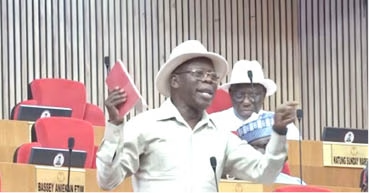
Oshiomhole’s persistent attempts to raise point of Order over the issue at the beginning of plenary Wednesday during adoption of votes and proceedings of Tuesday’s session, made him to incur the wrath of the Senate President, Godswill Akpabio who threatened to walk him out of the chambers if he refused to comport himself in line with Senate’s rules and procedures .
Trouble started when Akpabio during the adoption of votes and proceedings of the Tuesday session, got to number 194, 195 and 196, containing the amended rules of the Senate, particularly those on eligibility for position of Senate President and Deputy Senate President, and Oshiomhole shouted, “point of order” to prevent their adoptions.
Apparently aware of Oshiomhole’s plan, Akpabio ignored him by quickly reminding senators of procedures of plenary which according to him as stated in order 38, contains 8 different steps from opening prayers to matters of urgent public importance where point of order can be raised.
He consequently ruled Oshiomhole out of Order that was not in the first place, granted.
In giving life to Oshiomhole’s point of order, Senator Francis Ezenwa ( Imo East ) informed the President of the Senate that the Order Oshiomhole was raising, was point of privilege and not point of order, but Akpabio countered him by saying it falls on step 8 and not step 2 of procedure of proceedings which has to do with adoption of votes and proceedings.
Not satisfied with the explanations, unrelenting Oshiomhole shouted point of order again which made the Senate Whip, Senator Tahir Monguno (Kano North) to admonish him to be well guided by the Senate rules and procedures.
Angered by Oshiomhole’s persistent shouts of point of order Akpabio read order 20 of the Senate rules.
He said: “Let me be clear to you my colleagues, distinguished senators. Many people may not have seen this order, which is why I am reading it out.
“The Senate President is tasked with maintaining order during debates and giving rulings on points of constitutional order when they are raised.”
“He also has a casting vote in the event of a tie, but does not vote in any other circumstance. Most importantly, he has the authority to interpret the rules—this is clearly stated.
“So, dear senators we should not come into this chamber, especially on matters as serious as contested elections, without a proper understanding of the rules.
“Therefore, Senator Oshiomhole, let me state it finally that I can use this rule to take you out of the chamber if you are not ready to comport with the Senate rules and procedures”.
The contentious amendment Senate made on its rule is in order 5 which states, “Any Senator shall not be eligible to contest for any Principal Office of the Senate unless he has served as a Senator for at least two consecutive terms immediately proceeding nomination“, which means that senators who were not in the 9th and current 10th Senate, are not eligible to vie for presiding officers’ positions in the 11th Senate.
‘Senate rule change undermines democratic norms’
A political analyst, Professor Murtala Muhammad of North West University, Kano, raised concerns over the recent amendment to the Senate standing rules which bars first term senators from contesting presiding offices in the incoming 11th Assembly.
He described the move as a deliberate attempt at “institutional engineering deployed for political advantage.”
According to him, the reported amendment reflects deeper struggles for control within Nigeria’s legislature and highlights the fragility of democratic norms in the country’s presidential system.
“What appears as disorder in the chamber is more accurately understood as a revealing episode about institutional control, elite rivalry, and the fragility of legislative norms in presidential systems such as Nigeria’s,” he said.
Professor Muhammad explained that while legislatures are formally guided by rules, those rules often emerge from underlying power struggles. He noted that when eligibility criteria are adjusted in ways that appear targeted at specific actors, it amounts to what scholars call “procedural weaponisation.”
“This is the strategic use of institutional rules to shape outcomes rather than uphold neutrality. Such practices tend to flourish in contexts where institutional norms remain fluid, contested and insufficiently entrenched,” he observed.
He added that the rowdy nature of the Senate session in which the rule change was adopted was itself significant, pointing to weak institutionalisation and the erosion of deliberative norms.
“In more consolidated legislatures, disputes over procedural changes are typically managed through structured debate, negotiation, and committee review. When such disagreements escalate into open confrontation, it signals erosion of deliberative norms and a preference for imposition over consensus building,” he said.
The scholar warned that the selective alteration of rules to exclude perceived contenders undermines confidence in procedural fairness and weakens the credibility of the Senate as an independent institution.
“Normatively, these developments raise serious concerns about democratic integrity and institutional legitimacy. Ultimately, the episode reflects broader structural dynamics: the struggle for institutional control, persistent elite competition, and the enduring challenge of consolidating democratic norms within Nigeria’s political system,” he concluded.
National President of the Nigeria Political Science Association (NPSA), Prof. Hassan Saliu, said the move is not entirely new but reflects entrenched traditions and internal power dynamics within the Senate.
He noted that similar precedents exist, recalling that even former Senate leaders operated within such arrangements.
Prof. Saliu, however, pointed to growing speculation that the move may be targeted at specific political interests, particularly individuals believed to be nursing ambitions for the Senate presidency.
He questioned the timing of the proposed measure, noting that leadership contests are still some distance away.
“Why bring out the law now? This is not the time to elect leaders… the leader will be elected in over one year from now,” he added.
According to him, the development is deeply rooted in the internal manoeuvring within the National Assembly. “It is a reflection of the internal dynamics in the National Assembly, particularly the Senate,” Saliu explained, adding that such moves are often difficult for outsiders to fully grasp.
He further suggested that the initiative could serve as a preemptive strategy to limit the influence of incoming actors, including governors who may join the Senate and contest leadership positions.
Describing the situation as one driven by political survival, Saliu noted, “I see self-preservation there,” while acknowledging that those who feel targeted have the right to voice their concerns.
On the authority of the Senate, Saliu maintained that lawmakers are empowered to regulate their own procedures. “It has the power to regulate its rules… if members feel okay with the law, it becomes the law,” he said, stressing that due process must be followed.
He however highlighted the inherent political interests behind legislative decisions. “Behind every law, there are people who are going to benefit and there are people who are going to suffer.
But the irony of this is that Akpabio who benefited from the rule to emerge as the minority leader during the Senate Presidency of Bukola Saraki, is now the one allegedly leading its amendment to checkmate or deny others,” he stated.