

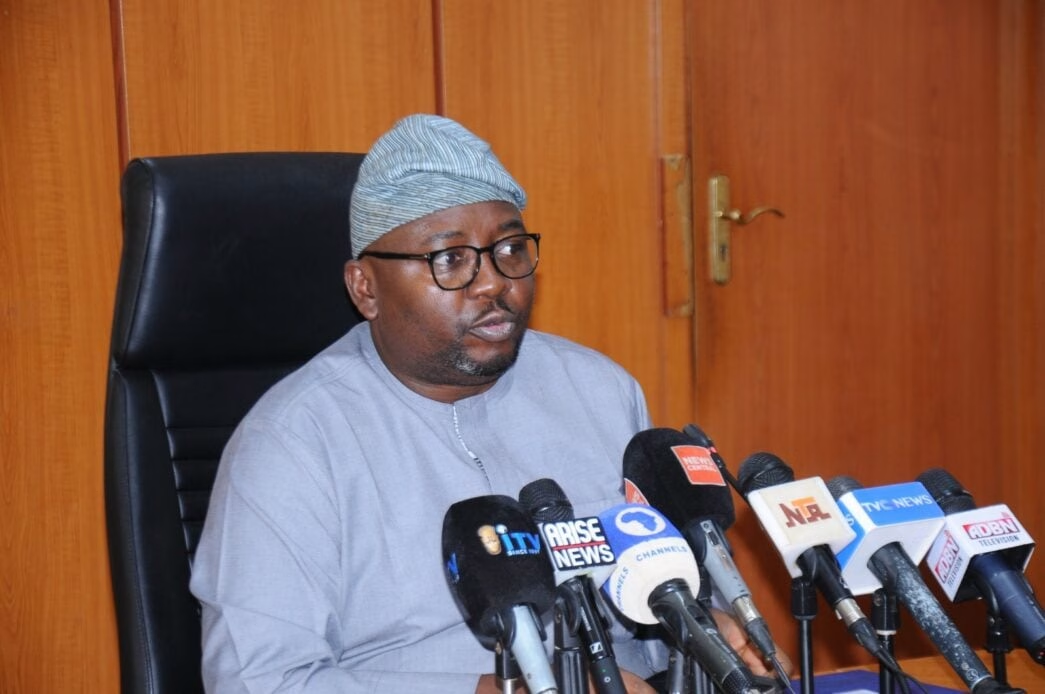
When Minister of Power Chief Adebayo Adelabu submitted his resignation letter to the presidency, he left behind a carefully constructed account of progress, one that paints a sector on the mend, buoyed by reforms, rising generation, and improving finances. But a detailed counter-analysis by the industry stakeholders suggests a more complicated reality: one where headline gains mask deep structural weaknesses that remain largely unresolved.
In his resignation letter, Adelabu struck a confident tone, declaring that “the sector has recorded measurable progress across the entire electricity value chain,” citing increased peak generation of “over 6,000 megawatts” and a financial reset driven by tariff reforms and debt restructuring.
Yet, data from the Association of Power Generation Companies (APGC) raises immediate questions about the reliability of those claims.
At the heart of Adelabu’s argument is the claim that Nigeria has crossed the 6,000MW threshold. But GenCos describe this as “partially representative,” stressing that peak generation is a fleeting metric—”momentary, not sustained.”
PEAK vs REALITY
Data spanning 2013 to early 2026 obtained from APGC shows a consistent pattern: while peak output has occasionally climbed above 5,000MW, the system routinely settles at an average delivery of just 4,200–4,500MW. In practical terms, that means what Nigerians actually receive falls far short of what is occasionally achieved.


Even in 2024, when peak generation hit 5,528MW, average supply hovered around 4,100MW, revealing a persistent gap of over 1,000MW between capability and reality. The report underscores that “it is the latter – not the former – that defines real sector performance.”
This directly challenges Adelabu’s framing of progress. While his letter notes that generation rose from 3,500–4,500MW in 2023 to over 6,000MW, the GenCos insist that such comparisons blur critical distinctions between installed, available, peak, and delivered capacity.
RISING DEBT, WEAK REVENUE
Adelabu also pointed to a “₦4trn debt restructuring programme” and rising market revenues—from ₦1trn in 2023 to ₦2.3trn in 2025—as evidence of financial recovery. But GenCos data tells a different story.
According to regulatory figures, the sector’s debt burden has not shrunk—it has ballooned. Total liabilities have climbed to about ₦6.8trn as of early 2026, with projections nearing ₦9trn by year-end. GenCos alone account for roughly ₦4.2trn of that exposure.
More critically, revenue collection remains weak. Only 30–40% of market invoices are being settled, leaving monthly shortfalls of up to ₦200bn. The report describes this as a “structurally impaired” system plagued by “chronic revenue under-recovery” and “delayed settlement cycles.”
Even flagship interventions cited by the minister appear to have limited real-world impact. A ₦501bn bond issued in late 2025, though fully subscribed, had yet to translate into meaningful liquidity for operators by the first quarter of 2026—highlighting what GenCos call a “disconnect between issuance and actual liquidity impact.”


AVALABILITY WITHOUT ACCESS
Adelabu acknowledged lingering issues around gas supply and infrastructure, noting that “gas supply constraints” remain a key challenge. However, the GenCos analysis reframes the problem entirely: it is not a shortage of gas, but a failure to pay for it.
With power sector debts mounting, gas producers are increasingly diverting supply to export markets where payments are more reliable and dollar-denominated. As a result, gas-to-power supply dropped by about 25% in early 2026, even as total national production remained steady.
The report lays out a blunt chain reaction: “Illiquidity → Non-payment → Supply diversion → Reduced generation.”
On infrastructure, Adelabu highlighted improvements under the Presidential Power Initiative, including new transformers and substations aimed at strengthening transmission. Yet GenCos, under the leadership of Joy Ogaji, argue that these upgrades have not fundamentally changed system limitations.
While theoretical grid capacity stands at 7,000–8,000MW, actual performance is constrained by instability, frequent collapses, and load rejection. Combined with gas shortages, this means a significant portion of available generation capacity remains stranded.
Despite an installed capacity exceeding 13,000MW, less than 35% is effectively utilised, a stark indicator of inefficiency across the value chain.
To be fair, the analysis does not dismiss all of Adelabu’s claims. It acknowledges “credible reform signals,” including tariff adjustments, increased revenues, and investor participation in government-backed bonds. These align with Adelabu’s assertion that reforms have “restored investor confidence” and positioned the sector for “long-term growth.”
But the optimism is tempered by hard realities. Weak contract enforcement, mounting debt, and operational uncertainties continue to weigh heavily on investor sentiment. Even government-backed interventions are seen as temporary fixes, with the report noting that ongoing debt clearance efforts amount to “a temporary reset, not a structural solution.”
MISSED DEADLINES
Acknowledging government’s inability to solve the power issues in the country, Adelabu recently apologised to Nigerians towards the tail end of his tenure.
“I want to apologise to Nigerians, officially now, coming from me as the Minister of Power, for this temporary issue that is leading to hardship being experienced, especially during this dry season, where there is so much heat everywhere.
“Businesses are being affected, schools have been affected, and industries have been affected. It is not our wish to find ourselves in this situation, but it is due to some factors that are actually beyond our control,” he had said.
Despite the current setbacks, the minister assured Nigerians that relief is imminent, giving a definitive timeline for improvement in supply.
“I can tell you, with the committee that we have set up, and commitments from gas suppliers, and the timeline for repair of the gas pipelines, two weeks from now, we should start seeing improvements in supply. Two weeks,” Adelabu said.
However, about one month after the pledge, Nigerians were greeted with the news of his resignation, raising questions about whether the reform is achievable.
Adding another layer to the debate, the President of the Nigeria Consumer Protection Network, Kunle Olubiyo, delivered a far more critical assessment of the sector’s performance over the years.
Speaking with Daily Trust, Olubiyo noted, “Frankly, the Nigerian electricity sector has fallen short of its core deliverables and has not met the expectations of Nigerians from November 2013 to date.”
He situated current challenges within a longer history of underperformance, arguing that beyond policy and reform narratives, the real constraint lies in financing and governance.
“Fixing the electricity sector is not rocket science. The real challenge is that government lacks the financial capacity to mobilise the scale of resources required to fix the sector. Electricity is capital-intensive – generating even 100 megawatts requires substantial investment,” he said.
GOVERNANCE CRISIS: CORRUPTION & COST INFLATION
Olubiyo also pointed to systemic inefficiencies and cost inflation in project execution.
“In some cases, projects that should cost around ₦100m are awarded for as much as ₦10 billion… This reflects a deeper culture driven by greed, weak institutions, and entrenched corruption,” he added.
On technical performance, he highlighted persistent transmission inefficiencies, noting that Nigeria continues to record high Transmission Loss Factors (TLF) compared to global standards.
“TLF represents the gap between energy generated… and what is eventually delivered. The current level is not acceptable or sustainable,” he said, warning that such gaps create room for “manipulation, corruption, and… energy theft embedded within the system.”
He stressed that accountability challenges cut across the entire value chain – from gas supply to generation, transmission, and distribution—largely due to weak metering and monitoring systems. According to him, the continued reliance on analogue infrastructure undermines transparency and efficiency.
“A functional smart grid infrastructure would enable real-time monitoring… and provide accurate, verifiable data,” Olubiyo said, arguing that without such systems, the sector remains vulnerable to data manipulation and operational inefficiencies.
He concluded with a broader institutional critique, calling for reforms that go beyond legislation.
“What is required is a deliberate overhaul of the system—starting with leadership recruitment and prioritisation of competence over political considerations,” he said, warning that without addressing systemic corruption and inefficiency, the sector risks remaining “a rent-seeking, profit-driven system rather than a public service.”
WORK IN PROGRESS
In many ways, both Adelabu and his critics converge on one point: the sector is still a work in progress. But where the former emphasises momentum and reform gains, industry operators and consumer advocates point to unresolved fundamentals, liquidity, governance, infrastructure, and accountability that continue to define Nigeria’s electricity reality.
The result is a power sector caught between reform and fragility. Until those gaps are addressed, Nigeria’s electricity story may remain one of potential—rather than performance.


