An investigation by Agence France-Presse (AFP) has revealed how the federal government paid a multimillion-dollar ransom to secure the release of up to 230 pupils and staff abducted from St. Mary’s Secondary and Primary School, Papiri, Niger State.
The abduction occurred on November 21 at the Catholic school, where nearly 300 pupils and staff were taken. At least 50 later escaped, according to the Chairman of the Christian Association of Nigeria (CAN) in Niger State, Most Rev. Bulus Dauwa Yohanna.
Nigerian government officials have consistently denied paying any ransom. The Department of State Services (DSS) previously stated that “government agents don’t pay ransoms.”
However, AFP cited four intelligence sources familiar with the negotiations who claimed that a “huge” sum was paid to secure the hostages’ freedom. One source estimated the amount at about 40 million naira per person, totalling roughly $7 million, while another placed the figure at about two billion naira overall.
The report further alleged that two Boko Haram commanders were released as part of the agreement, despite existing Nigerian laws prohibiting ransom payments to kidnappers and terrorists.
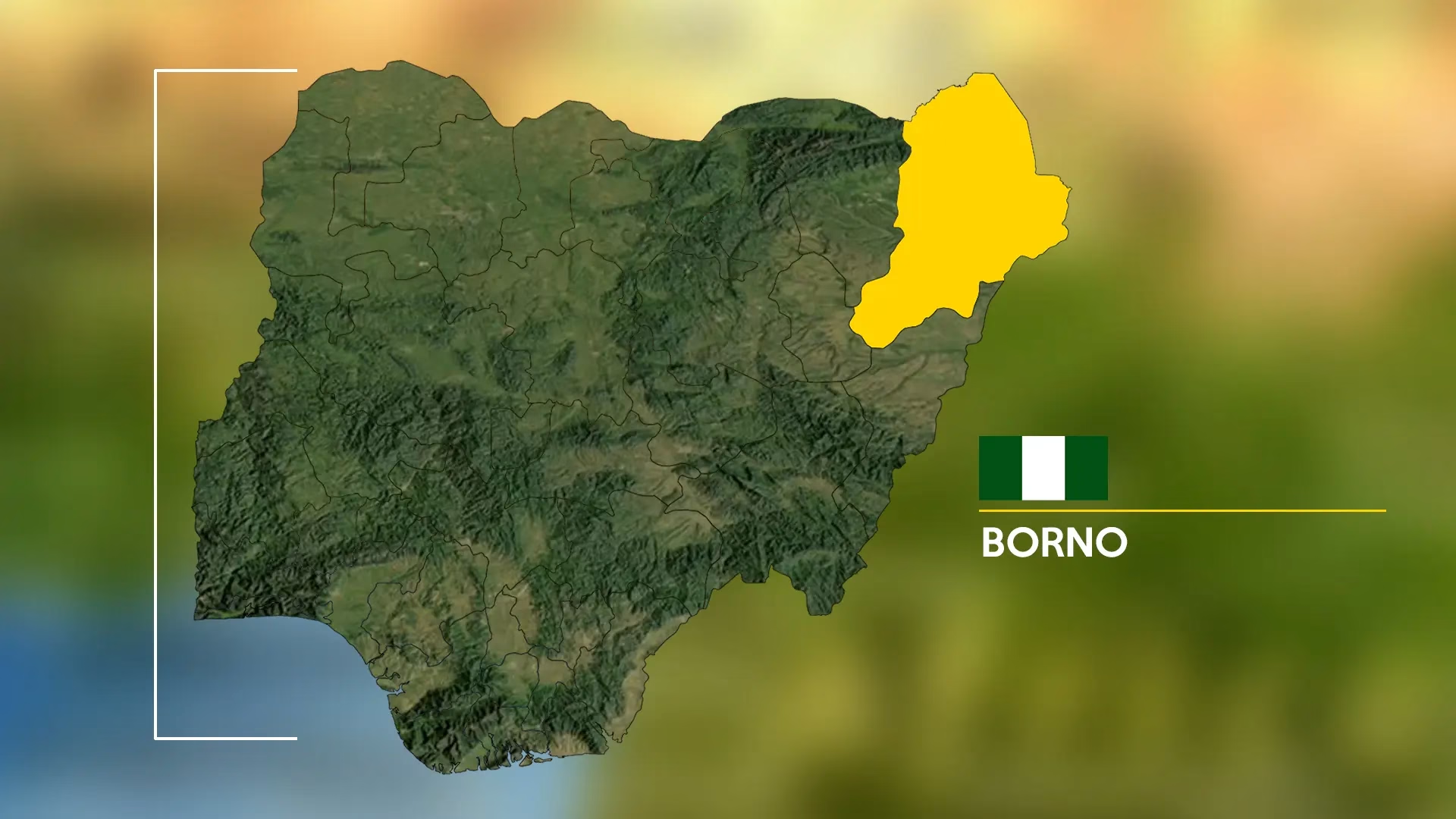
According to AFP, the funds were transported by helicopter to Gwoza in Borno State, a known Boko Haram stronghold near the Cameroon border.
Three sources told the news agency the money was delivered to a commander identified as Ali Ngulde. Due to limited communications coverage in the remote area, he reportedly crossed into Cameroon to confirm receipt before the first group of about 100 children was released.
While Boko Haram’s insurgency has largely been concentrated in the northeast since 2009, AFP reported that a faction led by a commander known as Sadiku was responsible for the Niger State abduction. Sadiku has previously been linked to high-profile attacks, including the 2022 Abuja-Kaduna train attack.
Negotiations for the release of the abducted pupils were reportedly led by the National Security Adviser, Nuhu Ribadu. Authorities maintained throughout the process that no ransom was paid. The federal government has not officially responded to the specific claims raised in the AFP investigation.
Legal framework against ransom payments
The allegations come against the backdrop of Nigeria’s strengthened legal stance against ransom payments.
In a bid to make kidnapping less lucrative, the Nigerian Senate in 2022 passed an amendment to the Terrorism (Prevention) Act 2013 prescribing a minimum of 15 years’ imprisonment for anyone who pays ransom to free kidnap victims.
The amendment followed consideration of a report by the Senate Committee on Judiciary, Human Rights and Legal Matters. Chairman of the committee, Senator Michael Opeyemi Bamidele, said at the time that “the overall import of this bill is to discourage the rising spate of kidnapping and abduction for ransom in Nigeria, which is fast spreading across the country.”
The law provides that anyone who “transfers funds, makes payment or colludes with an abductor, kidnapper or terrorist to receive any ransom for the release of any person who has been wrongfully confined, imprisoned or kidnapped is guilty of a felony and is liable on conviction to a term of imprisonment of not less than 15 years.”
Pattern of mass abductions
Nigeria has witnessed repeated high-profile kidnappings over the years, drawing concern both domestically and internationally.
In 2017, Chukwudumeme Onwuamadike, widely known as Evans, was arrested and arraigned before an Ikeja High Court in Lagos on charges including kidnapping and conspiracy. He was accused of operating a large-scale kidnapping ring and was popularly described in media reports as a “billionaire kidnapper.”
In January 2018, a notorious kidnapper and armed robbery suspect, Collins Ezenwa, popularly known as E-money, was killed in Imo State during a gun battle with operatives of the Special Anti-Robbery Squad (SARS). An Enugu-based politician, Tochukwu Okeke, had previously alleged that he paid $2 million in ransom after being abducted by E-money and his gang.
School abductions have also drawn global attention. In February 2018, Boko Haram insurgents attacked the Government Girls’ Science and Technical College in Dapchi, Yobe State, abducting 110 schoolgirls.
Most were released after negotiations, though five reportedly died during the abduction and one girl, Leah Sharibu, remained in captivity. Authorities did not disclose whether any ransom was paid.
In February 2021, armed bandits abducted 279 schoolgirls from Government Girls Secondary School in Jangebe, Zamfara State. The girls were later released following negotiations, though details of the discussions were not made public.
In March 2022, terrorists attacked and derailed a passenger train along the Abuja-Kaduna route, abducting dozens of passengers. Media reports at the time alleged that ransom payments were made for the release of some of the victims.
Other incidents have ended tragically. In July 2022, a US-based hotelier, Gbenga Owolabi, and a university student, Rachael Opadele, were abducted in Oyo State. Media reports indicated that ransom was demanded, but both victims were later killed.
In January 2024, gunmen attacked a family home in the Bwari Area Council of the Federal Capital Territory, abducting several family members. Media reports stated that ransom was demanded, and one of the victims was killed before the others were eventually released.